
EXECUTIVE INTERVIEWS > PUBLIC SECTOR
Sustain, Maintain & Educate
The successful development in Sudan lies in developing Sudanese individuals to be lifelong learners.
Dr Mohamed G. Hassan-Sayed is an associate professor of Chemical and Sustainable engineering and the director of programmes at the university of Southampton UK. An experienced academic with a demonstrated history of working in higher education and industry for 20 years. Skilled in Chemical and Petroleum systems, a Chartered Energy Engineer by the energy institute, and a Chartered Engineer by the institute of engineering and Technology. Strong engineering professional with over 100 publications and several book contributions. Dr. Hassan holds a PhD in Energy and Chemical Engineering from Loughborough University and a diploma in engineering management and another in education focused on vocational Education.
His career has been shaped with developing and accrediting courses in energy and chemical engineering at universities in the Middle East, North Africa and the UK. Dr. Hassan has an interest in the academic development of Sudan and has worked in the past with several universities and charity organisations in providing lectures, resources and knowledge transfer.
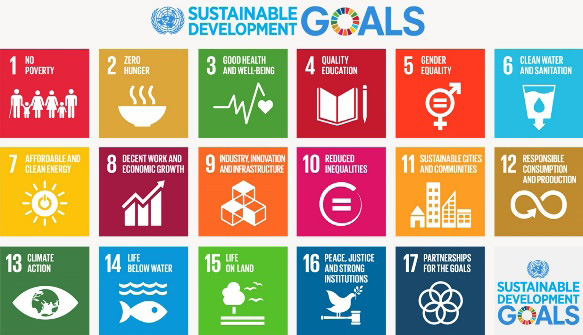
From the independence of Sudan in 1956 till now; the country operated on a legacy system of the colonial era failing to modernise and keep up with development. This is a product of lack of stable governance from the onset, leading to several army lead totalitarian system that has taken from the development of civil based infrastructural society; In addition to the vast tribal and ethnic diversity of Sudan that has led many internal conflicts which drained human capacity and resources over the past 65 years. Consequently the investment in development of the Sudanese individual has taken a back seat, lading a deterioration in health, education, equality, and infrastructure, that has impacted o the economic growth in all walks on life leading to high levels of poverty, with no sufficing energy and water provisions impacting on growth in most sectors. The UN has set out 17 sustainable development goals in Fig 1 that provide a breadth of opportunity for society to identify meaningful ways of contributing towards making progress for sustainability. For the Sudan future development the SDGs must be viewed as in Fig 2 made up of environmental/ biosphere, social/society, and economic/economy factors. For any movement overseeing the strategy for Sudan in the future it must focus on the society pillar by eradicating poverty, firming commitment to education and providing the means to affable living standards Fig 1 SDGs provide a breadth of opportunity for society to identify meaningful ways of contributing towards making progress for sustainability. Critical discussion around the SDGs is positive and beneficial as although they may not be perfect they offer an inroad to thinking about and taking action for sustainability in a tangible way. Fig 2 This way of looking at the SDGs links back to the three pillars idea and that sustainability is made up of environmental/biosphere, social/society, and economic/economy factors. This also shows that the economy only exists within society, and likewise, society within a functioning biosphere – in the same way as we need all three pillars we also need a healthy biosphere and a healthy society to enable a healthy economy to exist Partnership is shown as the ‘golden thread’ throughout all three pillers – much like Responsible Futures! Partnership is at the core of success in achieving sustainability aims.
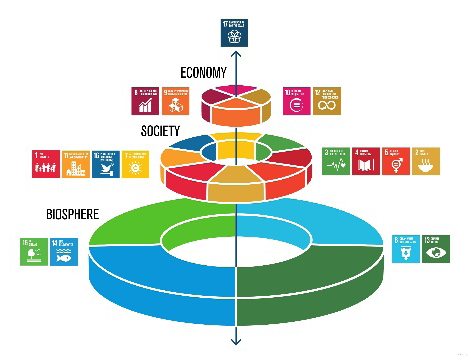
Sustainability is the heart of enhancing the quality of life as stated in the last question and should be viewed that economy is not the only success indicator but part of society, and likewise, society is a function of the living biosphere – in the same way as we need all three pillars we also need a healthy biosphere and a healthy society to enable a healthy economy to occur; with partnership between public and private sector as well and between governing and civil service as a ‘golden thread’ throughout all three pillars – much like Responsible Futures! Partnership is at the core of success in achieving sustainability aims. Sudan frankly speaking Is a failed state that cannot sustain its existence within the nations unless it adopts a comprehensive robust sustainability programme focusing on the pyramid of investment below
We need to define the short coming of Sudan over the past 30 years and ever longer from impedance which lie in the following: i. The view of education must change and be centric to any strategic development starting with shrinking the number of universities and bring more vocational training to establish a civil service that will lead to establishing a work force for development. ii. Financing of education should be the dominant part in the next few years to help in capacity development, this in an opportunity for the private sector to invest in developing the next generation of work force and defined the gap in skills need to help Sudan develop. iii. E-learning infrastructure should be centric to the new government strategy in preparing Sudan for a sustainable renaissance in development, this is also a good opportunity where the private sector and communication company can help in develop an educated Sudanese eradicating the need for demanding physical infrastructure to a cloud base system that will bring development to all Sudanese. iv. Independence of education from political influence and affinity the autonomy to select leaders including the shaping of direction and strategy of ministries of education and higher education away from military and political ideology. v. Restructuring in Education particular in higher education no political or military based influence that quenches creativity, voice, and passion. Bring back the vocational training as a centric part to development as an academic stage for school leavers and prerequisite to entering work force. Reducing the number of universities in the country to establish a niche university education that does not lead to the a labour force but to serving the civil society through a civil service system. vi. Modernisation of the syllabus and removing redundant units vii. Quality over all must be centric to the vision of the any government in charge of Sudan not only to eradicate illiteracy and ignorance but to stablish an enlighten civilised community that is the focus on development and the prevention of the current factors on decline such as tribal and religious fanaticism. viii. Innovations, investment, and independence in education to eradicate corruption, to have an open system in governance for educational entities for autonomy transparency and control in generating and income to enable learning at all levels. ix. Criteria for continues assessment in syllabus to develop a robust educational system at all levels that meets the needs of the work market today and in the future. One that creates a well learned society that has at the heart of it long life association with learning for continues improvement for bettering societal needs. x. Ranking and international coloration to enable the development of the educational system to meet the moto of the revolution freedom, peace, and justice for all.
To execute a robust development program the governance in Sudan should focus on the following:
Enabling Environment: Security, Law and Order through Achieve political stability and security, establish a legal and regulatorily framework, and secure rights and enforce of contracts to encourage investment.
Good Governance and Capable Institutions Improving governance central to achieving economic development through combatting corruption and establishing adherence to rule of law. There is also a need to focus on reshaping values and norms of state and governance – Emphasis honesty, integrity and service to society, performance and resultsorientation, transparency and accountability. The main element to the future success for Sudan which was demolished over the past 30 years is imperatives of reforming civil service the public sector capacity and institutional challenges would adversely impact policy design and implementation of change. Civil service reforms are crucial to re-professionalize the service, improve policy formulation/execution capacity as well as enhance service delivery.
Stable, predictable economic/ financial Environment: The primacy of sound macroeconomic policies in creating an enabling environment through the Stable Prices; Competitive Exchange Rates; Buoyant External Reserves; Sustainable fiscal policy; as well as Effective coordination between monetary, fiscal and exchange rate policy. Another elements is Improving macroeconomic management and financial regulation strengthen fiscal rule, rebuild fiscal buffers and pursue counter-cyclical fiscal policies. Enhance access to financial services for productive sectors and to meet needs of microenterprises and SMEs.
Investment in Physical and Social Infrastructure Rebuilding and expanding physical infrastructure deficit, particularly in energy sector as major constraint to growth hampers productivity, SUDAN BUSINESS MAGAZINE 13 raises cost of doing business and undermines competitiveness and trade. There must be a “Big Push” critical to securing future growth and economic diversification. Key efforts should focus on Energy, agriculture, transportation, and infrastructure. Improved government spending is a key, effective leveraging of private sector investment required (PublicPrivate-Partnerships).
Proactive Support for Real Sector Growth: Investment in health and education key to unlocking economic growth potential and supporting diversification through developing a productive work force; pay more attention to the neglected area of technical and vocational education, to impart relevant skills and bridge jobsskills mismatch; promote science, technology and innovation to leapfrog into industrial revolution Mobilization and Effective Utilization of Resources, Supporting Real Sector Growth Agriculture Boosting production and exports. Is a major source of employment and incomes as well as important for poverty reduction. Agriculture in Sudan is a High growth potential, with economic diversification butting in mind only 60% of 220 million ha arable land under cultivation, currently has a low yields per hectare (20-50% below that of other developing countries). Agriculture could be a gateway linkages to support industrialization and an integral part to that is essential for improving food security. Sources of agricultural growth should be captivated in technological innovation and productivity improvement, improvement of infrastructure for agricultural production and commercialization, Improvements in input supply and distribution systems, Improved access to finance. Strengthen value chain approach measures aimed at boosting agricultural production to be complemented with improvements in transport, storage and processing. Supporting real sector growth: Industrialization as a key component to Sudan’s economic diversification and structural transformation, major source of productivity increase and technological innovation. Key constraints to sector growth include inadequate power supply, high cost of inputs, high cost of doing business, infrastructure deficit, and limited access to finance. Crucial role for government in facilitating industrial transformation by taking advantage of emerging industrial opportunities to fill the niche created by graduation of China, India, Brazil, etc from low-skilled to more capital-intensive production. Provision of soft (skilled labor force) and hard infrastructure by the state key to actualizing potential. Cluster-based approach (Export Processing Zones, Industrial Parks).
The Key element in to securing funds and developing Sudan is centric to a primacy of a neutral leadership that is Sudan centric independent of military intervention and away from local and international ambitions shaped by the following:
i. Focused, credible, trustworthy and effective leadership is key to achieving economic development.
ii. Leadership is not a one-person endeavour. A strong team needed that shares common ideals; a critical mass of credible leaders (cabinet, advisers, etc), men and women of integrity, ability and track record.
iii. Key leadership task is providing an inspiring vision and instilling in the mindsets of Sudanese a compelling need for change, anchored on a unity of purpose.
iv. Tough decisions which demand end to business as usual
v. Movement out of comfort zone – from transactional to transformational space.
vi. Trust-building measures needed in current trust- deficit environment arising from legacy of past leadership and misrule.
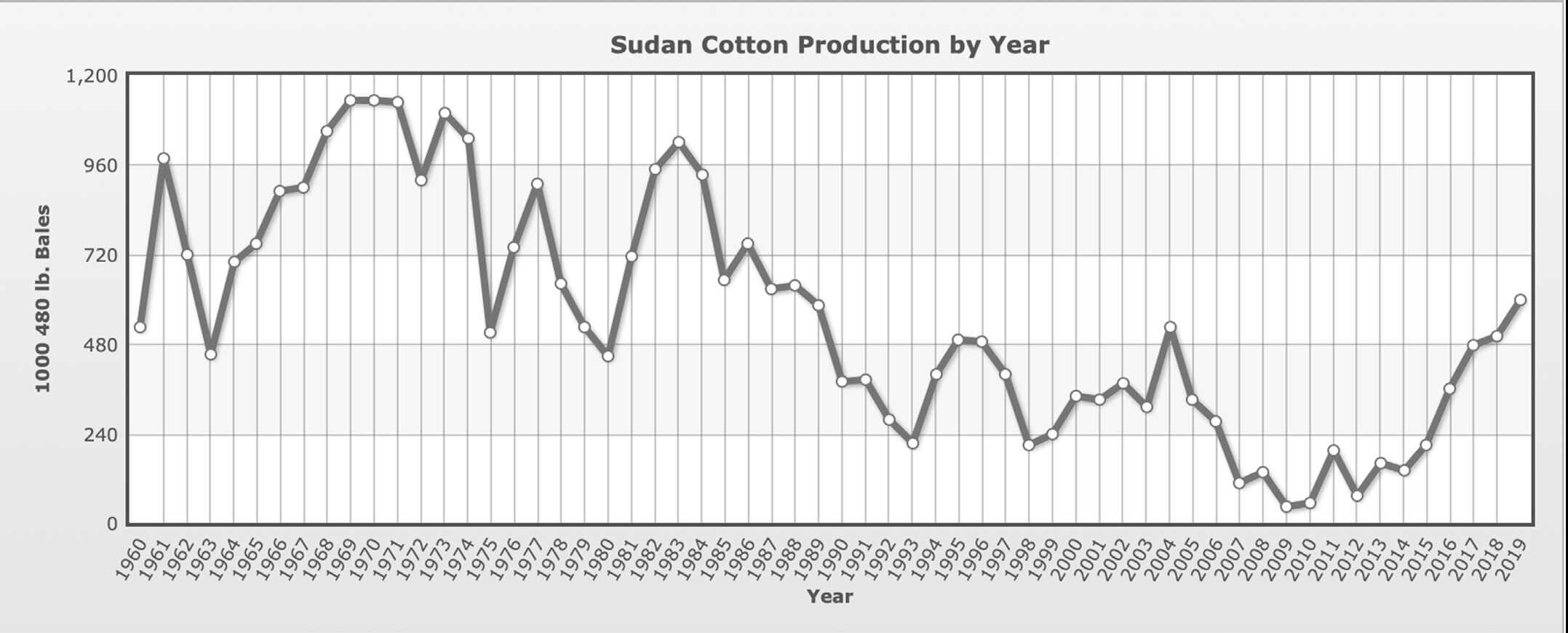
To answer this question we need to have a look at the history of activities in Sudan. Between the periods of 1956-1999 Sudan relied heavily on the agricultural sector for foreign exchange earnings, where cotton, sesame and gum arabica accounted for 42.8%, 12% and 14% of the total exports. In the period 1999-2010 crude oil accounted for 83% of the total nation exports leading to a decline in cotton production as per graph below. This was a result of many factors such OPEC increased the price of crude oil due to the first and second gulf war in the 1990’s, coupled with the stiff economic embargoes on Iran & Venezuela and the resurgence of the Asian economies, mainly China and India meant that oil demand had peaked while supply was relatively short; a boom was to be experienced in full effect led to change in Sudan oil policy triggering a decline of the agricultural sector; in-terms of yearly production.
If we analyse the 1999 to 2010 period it becomes clear that the combined ratio of imports and exports to GDP increased by 22% points. This is up from a 17% average over 1970-99. In addition, the ratio of direct foreign investment to GDP also surged from the lowest in historical records to an average of 5.5% from 1998-2010. A measure of the total economic output of Sudan per person (adjusted to inflation) increased by 0.6% during the period of time in which cotton was the chief export material- between the period of 1960-1998, in comparison to an increase a 70% increase in real GDP per capita between the periods of 1999-2010 when oil production commenced in Sudan.
In the year 2010/11 the Sudan changed significantly with the secession of South Sudan, and 75% of Sudan’s oil fields and two-thirds of its economic revenue were handed over to the new nation. If we move forward in time to the year 2017/18 Sudan was suffering from the Dutch disease (curses of resources) for a second time the first one was due to cotton exports and investment during the condominium rule of the UK and Egypt. In 2017 Sudan Exported in the region of $4.6 billion, it’s this value that makes it the 110th largest exporter worldwide. Although 32% of the exports were gold, Sudan contributes only 4% of the worlds gold exporters giving it a 4% share of the $37.9 billion industry. But Sudan was classed as the 120th most complex this information is gathered by ECI – Economic Complexity Index, in total Sudan imported $9.9 billion in 2017 making it the 91st largest importer in the world, although this shows both parts to the picture it doesn’t show a true comparison of Sudan’s trade balance.
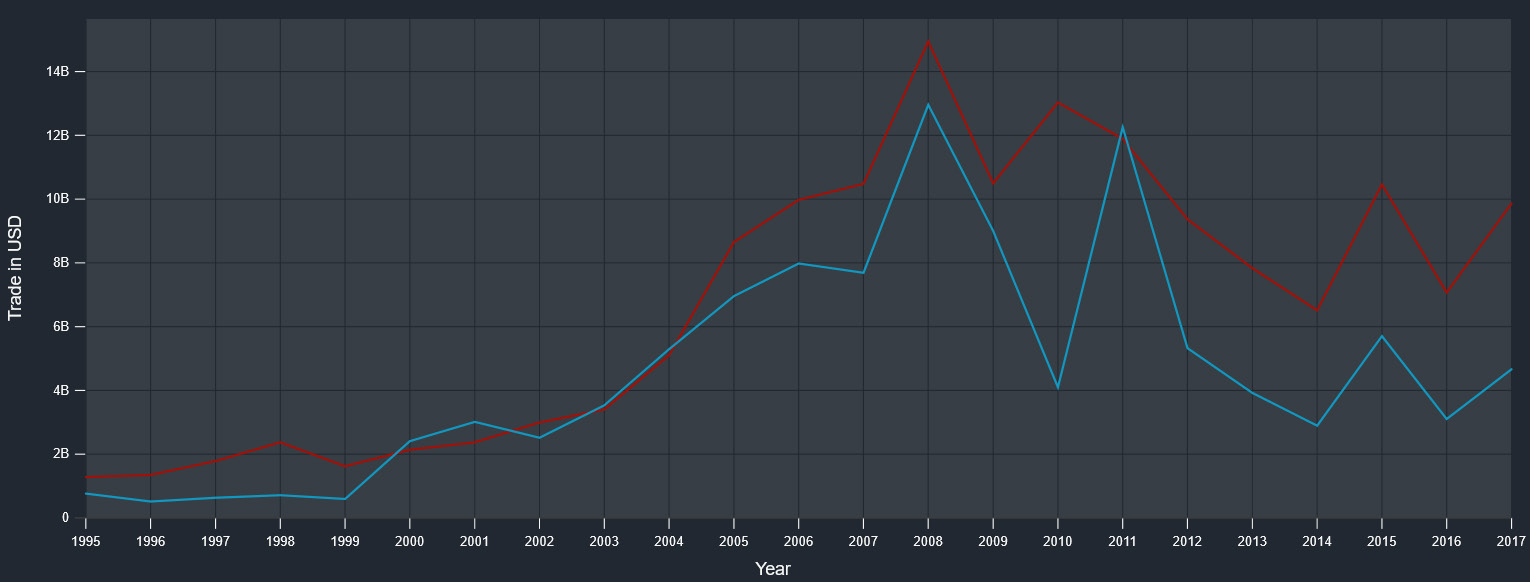
Sudan has a negative trade balance of $5.2 Billion in net imports, Sudan imports more than exports with a single exception in 2011. Sudan as had a negative trade balance since before 1995 although it was considerable smaller at only $516 Million. Over the last 10 year, Sudan has had it’s up and downs when looking at it’s GDP
Leading to high levels of inflation and devaluing the currency and the welfare of Sudanese’s. the Dutch disease is apartment in the fact the government invested heavily in the infrastructure of oil and gas/ mineral exploration with no apparent investment in education health and infrastructure. Capacity development was ignored over 30 years leading to decline in the Sudanese’s enlightens, and morals. Bringing it back to my early point about redevelopment of Sudan through education.
Other factors of Oil dependency in Sudan is a depression of the agricultural sector; mostly cotton and the loss of economic diversification. Also total Major Exports of Sudan $4.6B Major Imports of Sudan $9.9B factor of productivity and growth (TFP) has increased over time, it’s readings have been negative throughout the period of oil production and hindered real growth and diversification through innovation. The appreciation of the real exchange rate while negative contribution to TFP growth were experienced, resulted in a loss of competitiveness.
So to come back to your question the economical decisions should be based on capacity development and education we should put all infrastructure decisions centric to health, water and energy needs. The global community supporting a new government should help in imparting knowledge and developing the infrastructure not provide donation. But also the government need to diversify its investment in all scoter in term of export and infrastructure development to avoid the repeat of the Dutch illness in economy. Import over Export Sudan (Oec.world, 2019) Sudan’s trade balance with the Blue line indicating exports and the red line indicating imports.
“It is the duty of every citizen according to his best capacities to give validity to his convictions in political affairs.” Albert Einstein. I am not a politician, nor do I have an affinity to a political movement or party in Sudan. I am an academic and my career is shaped through my academic and scholarly activates. I am more than happy to commit time to the support the development of Sudan as an advisor and I already support the Sudan Knowledge Group and the World Association for Sustainable Development. Both organisations are a global forum that brings together experts from across the world to discuss issues relating to sustainable development, science and technology management in Sudan without promoting any kind of political views and/or ideologies among the different stakeholders in and outside Sudan.
Sudan Business Magazine